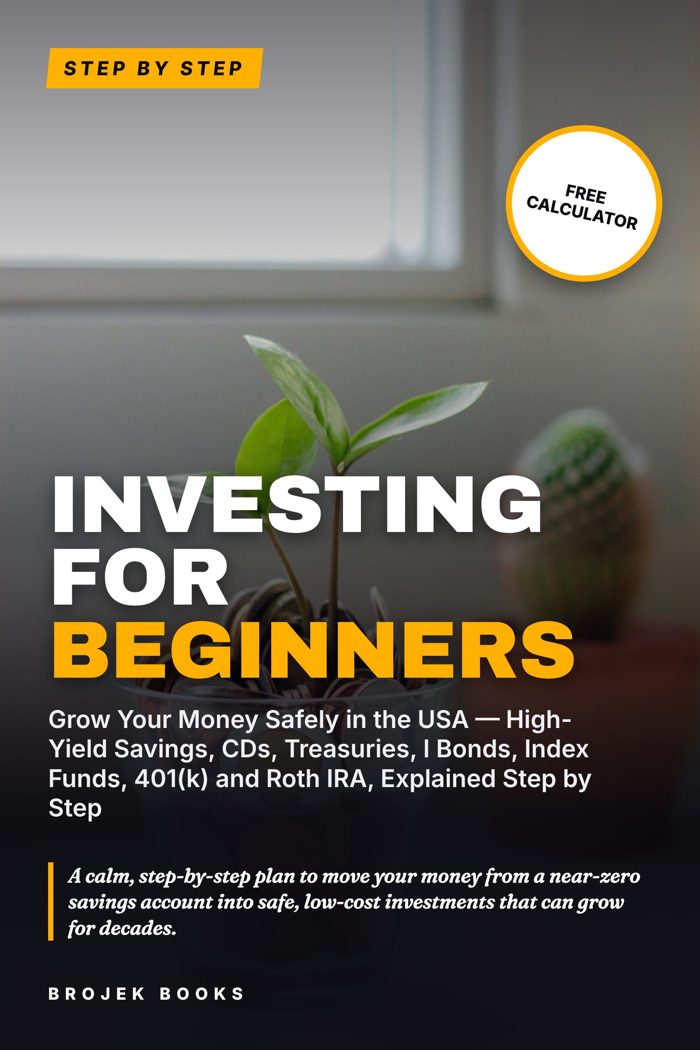
Investing for Beginners
Grow Your Money Safely in the USA — High-Yield Savings, CDs, Treasuries, I Bonds, Index Funds, 401(k) and Roth IRA, Explained Step by Step
A calm, step-by-step plan to move your money from a near-zero savings account into safe, low-cost investments that can grow for decades.
What you get
- The right order: emergency fund, match, debt, then investing
- Compounding tables for 3%, 5% and 7% over 5 to 30 years
- HYSA, money market, CDs, CD ladders, T-bills, I bonds and TIPS compared
- Bond duration and fund fees explained with worked examples
- 401(k) match, Traditional vs. Roth and IRAs made simple
- Three sample portfolios by goal and age, plus rebalancing
- Step-by-step guide to opening an account and buying your first fund
- Comparison worksheet, 30-day action plan and a free growth calculator
You know you should be investing. But between savings accounts, CDs, Treasuries, I bonds, index funds, 401(k)s and Roth IRAs, it is hard to know where to start, and even harder to know whom to trust. This book gives you a calm, step-by-step path from your first emergency fund to your first index fund purchase, in plain English and with real numbers.
You will learn the order of operations that keeps you from being forced to sell at the worst time. You will see exactly how compounding works, with the formula, a worked example and tables calculated for 3%, 5% and 7% over 5 to 30 years. You will understand inflation, why "safe" bond funds can still lose money (with a worked duration example), and why a 1% fee can cost you more than $100,000 over a career.
Each safe tool gets its own chapter: high-yield savings, money market accounts and funds, CDs and CD ladders, Treasury bills, notes and bonds (including the state-tax advantage and TreasuryDirect vs. a brokerage), plus I bonds and TIPS. Then you will learn how a 401(k) match, Traditional vs. Roth, IRAs and a taxable brokerage account fit together.
Finally, you get three sample portfolios for real goals, click-by-click instructions to open an account and place your first order, the 12 mistakes and scams that hurt beginners most, a comparison worksheet and a 30-day action plan. Readers also get free access to our online growth calculator to run their own numbers.
Educational content only, not financial advice. Rules and limits change, and the book shows you where to check them.
What's inside
- Read This First: A Calm, Honest Path From Savings to Investing
- Before You Invest a Dollar: The Order of Operations
- The Math That Makes You Rich Slowly: Interest and Compounding
- Inflation: The Quiet Tax on Your Cash
- High-Yield Savings and Money Market Accounts: Your Safe Home Base
- CDs and the CD Ladder: Lock In a Rate Without Locking Up All Your Money
- Treasury Bills, Notes and Bonds: Lending to Uncle Sam
- I Bonds and TIPS: Money That Keeps Up With Prices
- Bond Funds and Duration: Why "Safe" Bonds Can Lose Money
- Index Funds and ETFs: Own the Whole Market for Pennies
- 401(k), IRA and Roth IRA: The Tax Breaks That Supercharge Compounding
- The Taxable Brokerage Account: Flexible Money for Any Goal
- Asset Allocation: Three Sample Portfolios for Real Goals
- Opening Your Account and Making Your First Investment, Step by Step
- 12 Mistakes and Scams That Cost Beginners the Most
- Your Comparison Worksheet and 30-Day Action Plan
Read a sample
Read the bottom row carefully. Over 30 years you deposit $109,000 no matter what. At 3% you end with about $177,000. At 7% you end with about $374,000, more than double. The extra 4 percentage points a year are worth roughly $197,000. That is the difference between parking long-term money in cash and investing it in a diversified mix that has historically earned more, with more ups and downs along the way. Also notice the top row. Over 5 years, the rate barely matters: $20,556 versus $22,895. For short time frames, safety matters more than return. For long time frames, return matters enormously. This single observation drives the whole structure of this book: short-term money goes in safe tools; long-term money goes in growth tools. Two people invest $300 a month at a hypothetical 7%, compounded monthly, and stop at age 65. The early starter deposits only $36,000 more but ends with more than twice as much. The last ten years of compounding do the most work. If you are older, do not panic; it means your contribution rate matters more, and the tools in Chapter 11 can help you catch up.
Questions
What format is it?
A PDF ebook you download right after purchase. It works on phones, tablets, Kindle apps that open PDFs, and computers.
How do I get it?
After checkout you get a download link by email and on the confirmation page.
Who wrote it?
Brojek Books, the publishing imprint of Brojek Games (brojekgames.com).
 The AI Toolbox
 500 AI Prompts That Actually Work
 Candlestick Charts Made Simple
 The Debt-Free Blueprint
 Conversational Spanish in 30 Days
 Unhooked
 Grow Your Own Food
 World Travel Manual