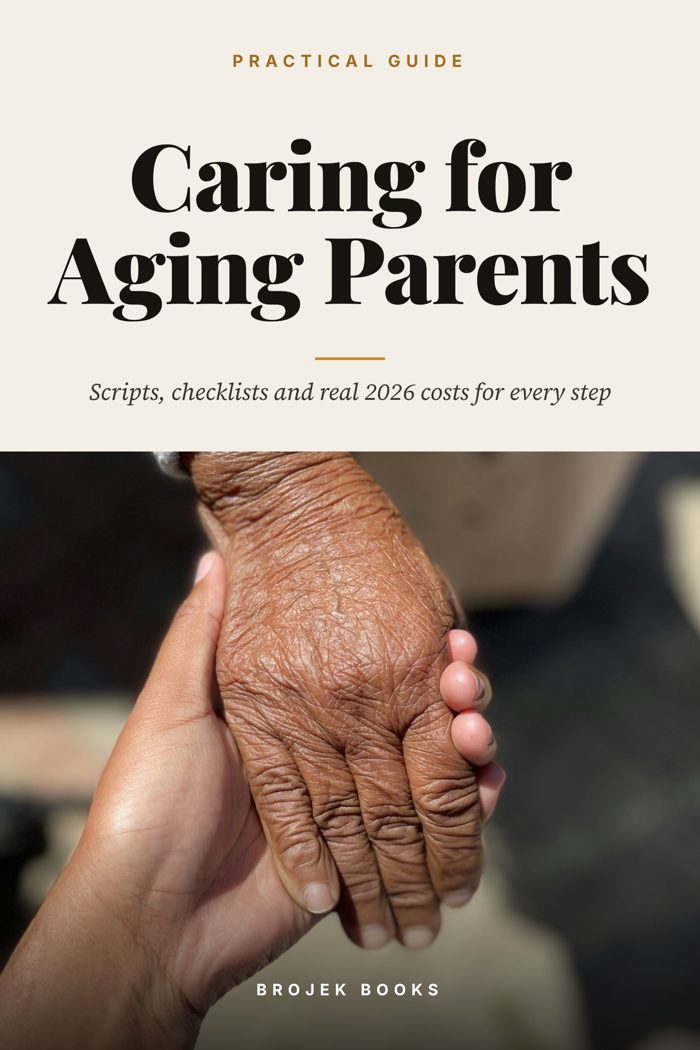
Caring for Aging Parents
The Practical Guide for Adult Children: Scripts for the First Conversation, Home Safety, Real Care Costs, Medicare, Medicaid and VA Benefits, Legal Documents, Money Management and Caregiver Support
A clear, step-by-step plan to help your parent age safely, pay for care wisely and keep your own life intact.
What you get
- Word-for-word scripts for talking with your parent and siblings
- ADL and IADL needs worksheet that turns observations into care hours
- Room-by-room home safety checklist
- 2025 CareScout care costs and worked budgets with real numbers
- Medicare, Medicaid look-back, VA Aid and Attendance and LTC insurance explained with 2026 figures
- Legal documents checklist and document locator template
- Money, medication and scam-prevention systems you can set up this month
- A 30-day action plan and official source list
Your mom fell. Your dad's bills are piling up. Or you just have a feeling that something is changing. Suddenly you are expected to understand care options, Medicare, Medicaid, legal documents and family logistics, often while holding down a job and raising your own family.
Caring for Aging Parents is the organized, practical plan you need. It starts with word-for-word scripts for the first conversation with your parent, including what to say when they refuse help. It shows you how professionals assess needs using ADLs and IADLs, then walks you room by room through a home safety checklist.
You get every care option explained, from a few hours of in-home help to memory care and nursing homes, with the latest national prices from the CareScout 2025 Cost of Care Survey and worked budgets that show how long savings will last. You will finally understand what Medicare does not cover, how Medicaid long-term care and the five-year look-back work, what VA Aid and Attendance pays in 2026 and how to put a long-term care policy to work.
The book covers the legal documents every family needs, FMLA and state paid leave, programs that pay family caregivers, managing medications and appointments, taking over bills safely, stopping scams and elder financial abuse, sharing the work with siblings, caring from far away, preventing burnout with respite and having end-of-life conversations.
Every chapter is built for action: checklists, templates, scripts and a 30-day plan, plus a list of official sources so you can check current rules. Educational guidance, not legal or medical advice, written to help you act with confidence.
What's inside
- Start Here: What to Do This Week, and How to Use This Book
- The First Conversation: Scripts for Talking With Your Parent
- What Help Do They Really Need? Assessing ADLs, IADLs and Safety
- A Safer Home: The Room-by-Room Checklist
- Every Care Option Explained, From a Few Hours a Week to 24/7
- What Care Really Costs: 2025 Survey Numbers and Real Budgets
- Who Pays: Medicare, Medicaid, VA Benefits and Long-Term Care Insurance
- The Legal Papers Every Family Needs Before a Crisis
- Keep Your Job and Maybe Get Paid: FMLA, Paid Leave, Caregiver Pay and Taxes
- Medications, Appointments and the Care Binder
- Taking Over the Money: Bills, Accounts and Benefits
- Stop Scams and Financial Abuse Before They Start
- Siblings, Spouses and Caring From Far Away
- Protect Yourself: Burnout, Respite and Where to Find Help
- The Hardest Talk: End-of-Life Wishes, Palliative Care and Hospice
- Your 30-Day Action Plan and Official Sources
Read a sample
Most families wait too long to talk. The conversation feels like an accusation ("you can't take care of yourself anymore"), so everyone avoids it until a fall or a hospital stay forces it. By then, choices are fewer and emotions are higher. The goal of this chapter is to help you start early, keep it respectful and come away with at least one small agreement. Write down the specific things you have noticed, with dates. "The stove was left on twice in March" works better than "you're getting forgetful." Decide on your one goal for this first talk. Not ten goals. One. Examples: agree to a doctor visit, agree to try a cleaning service, agree to sign a health care proxy. Talk to your siblings first, if you have them, so nobody is ambushed and nobody undermines you. Chapter 13 has a script. Choose the right setting: private, unhurried, not during a holiday meal, not right after an argument. Pick the right messenger. Sometimes the best person is not you. It may be a sibling your parent listens to, a trusted doctor, a pastor or an old friend.
Questions
What format is it?
A PDF ebook you download right after purchase. It works on phones, tablets, Kindle apps that open PDFs, and computers.
How do I get it?
After checkout you get a download link by email and on the confirmation page.
Who wrote it?
Brojek Books, the publishing imprint of Brojek Games (brojekgames.com).
 The AI Toolbox
 500 AI Prompts That Actually Work
 Candlestick Charts Made Simple
 Investing for Beginners
 The Debt-Free Blueprint
 Conversational Spanish in 30 Days
 Unhooked
 Grow Your Own Food