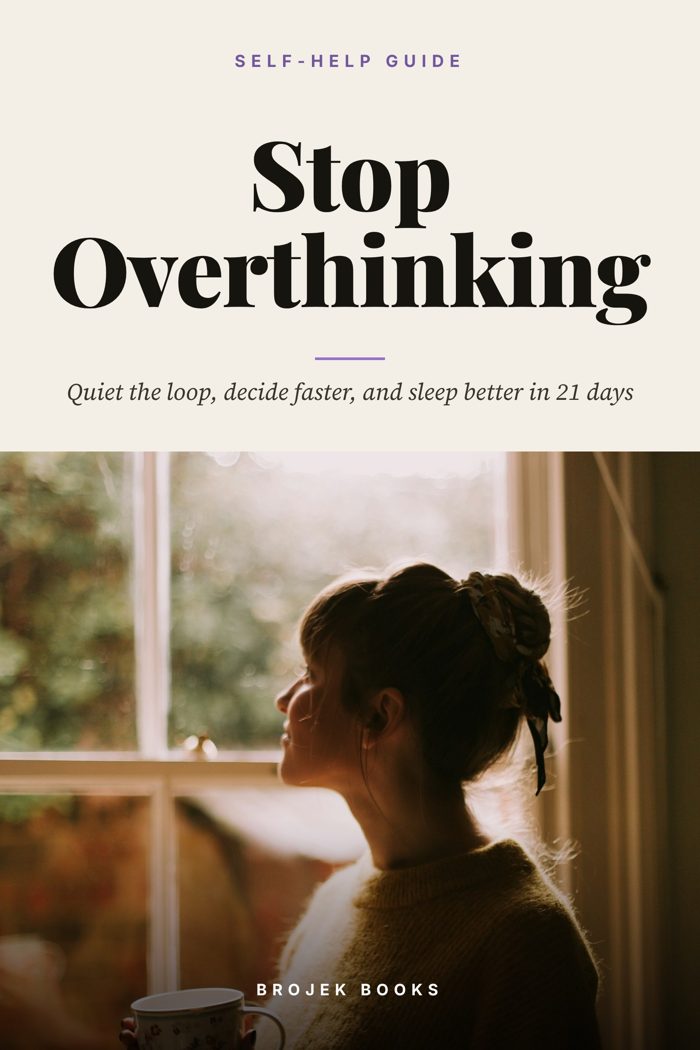
Stop Overthinking
Practical, Research-Informed Self-Help Tools to Quiet Worry, Break Rumination Loops, Decide Faster and Sleep Better, with Thought Records, Worry Time, Decision Rules, Journaling Prompts and a 21-Day Plan
Break the overthinking loop with simple, research-informed tools you can practice in 10 minutes a day.
What you get
- Tell problem-solving from worry and rumination in seconds
- Cognitive distortions field guide with counter-questions
- Step-by-step thought records with worked examples
- Scheduled worry time and a bedtime worry download
- Decision rules: 10/10/10, good-enough choosing, deadlines and more
- Tools for perfectionism, social replays and overthinking texts
- Journaling prompts, mindfulness basics and a calmer phone setup
- A 21-day plan plus clear guidance on when to seek professional help
It's 11:47 p.m. and you're replaying something you said in a meeting, decoding a friend's one-word text, and comparing the same three options for the fifth time. Your body is tired. Your brain is running a marathon.
Stop Overthinking gives you a clear, practical way out of the loop. You'll learn to tell useful problem-solving from worry and rumination, then use well-established self-help techniques drawn from cognitive behavioral approaches: the cognitive distortions field guide, a step-by-step thought record with worked examples, scheduled worry time, and a five-step problem-solving method that turns looping into action.
For decisions, you'll get a toolkit that ends the agonizing: the 10/10/10 rule, good-enough choosing, decision deadlines, personal policies, the two-minute rule and the pre-mortem. For nights when your brain won't shut off, there's a 15-minute bedtime worry download. You'll also find mindfulness basics without the mystique, tools for perfectionism and procrastination, specific strategies for overthinking texts, conversations and relationships, a calmer phone setup, and dozens of journaling prompts.
Research is cited only when it can be checked. Every chapter ends in practice, and a 21-day plan tells you exactly what to do each day. This is self-help, not therapy, and the book includes a kind, clear guide to when and how to reach a licensed professional, plus the 988 Suicide & Crisis Lifeline.
What's inside
- Start Here: Your Mind Is Trying to Help (It Just Overdoes It)
- Worry, Rumination, and Real Problem-Solving: Know the Difference
- Catch It Early: Mapping Your Overthinking Patterns
- Thoughts Are Not Facts: The Cognitive Distortions Field Guide
- The Thought Record: Untangle a Spiral on Paper
- Worry Time: Give Your Worries an Appointment
- From Looping to Doing: A Five-Step Problem-Solving Method
- Decide Faster: Rules for Choosing and Living With It
- The 2 A.M. Brain: A Bedtime Worry Download
- Mindfulness Without the Mystique
- Overthinking People: Texts, Conversations, and Social Replays
- Your Phone, the News, and the Overthinking Feed
- Perfectionism, Procrastination, and the Fear of Getting It Wrong
- Journaling Prompts That Actually Get You Unstuck
- When to Reach Out: Getting Professional Support
- The 21-Day Plan to Think Less and Live More
Read a sample
Not all thinking is overthinking. Thinking hard about a decision, a plan, or a problem is often exactly what you need. The trouble starts when thinking stops moving forward and starts going in circles. This chapter helps you tell the difference, which is the foundation of everything else in the book. Three kinds of thinking Type Focus Sounds like Result Problem-solving A specific, solvable problem "What are my options? What's the next step?" A decision or an action Worry The future: what might go wrong "What if I lose my job? What if they say no? What if...?" Anxiety, more what-ifs Rumination The past or the self: why things happened, what's wrong with me "Why did I say that? Why do I always mess up? Why me?" Low mood, self-criticism, feeling stuck Psychologist Susan Nolen-Hoeksema, whose research shaped how psychologists understand rumination, described it as repetitively focusing on one's distress and its possible causes and consequences, rather than on solutions.
Questions
What format is it?
A PDF ebook you download right after purchase. It works on phones, tablets, Kindle apps that open PDFs, and computers.
How do I get it?
After checkout you get a download link by email and on the confirmation page.
Who wrote it?
Brojek Books, the publishing imprint of Brojek Games (brojekgames.com).
 The AI Toolbox
 500 AI Prompts That Actually Work
 Candlestick Charts Made Simple
 Investing for Beginners
 The Debt-Free Blueprint
 Conversational Spanish in 30 Days
 Unhooked
 Grow Your Own Food