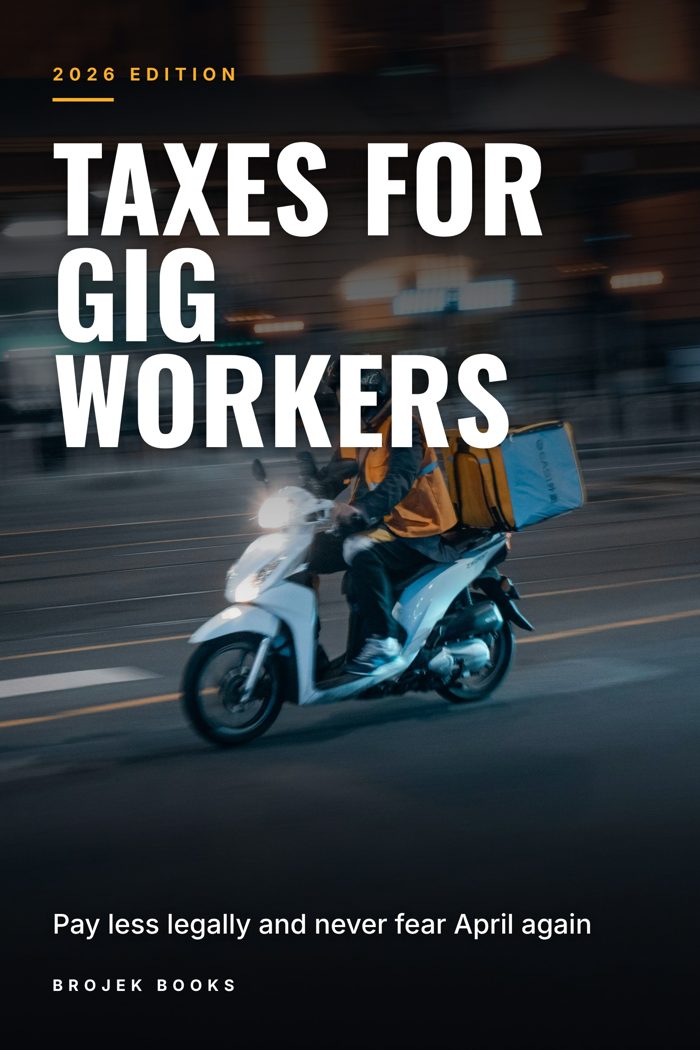
Taxes for Gig Workers
The Plain-English Guide for Rideshare and Delivery Drivers, Online Sellers and 1099 Freelancers: Pay Less Legally, Track Every Deduction and Never Fear April Again
Understand exactly how your gig income is taxed, claim every deduction you are entitled to, and pay the IRS on your schedule instead of in a panic.
What you get
- Self-employment tax, Schedule C and Schedule SE explained line by line
- Standard mileage (70 cents for 2025, 72.5 cents for 2026) vs actual expenses, with real math
- The 2025 law changes: $20,000 1099-K threshold, $2,000 1099-NEC, tips deduction, permanent QBI
- Quarterly estimated taxes made simple with the safe harbor rule
- SEP-IRA, Solo 401(k) and health insurance deductions with 2026 limits
- Three complete worked returns: driver, freelancer and Etsy seller
- What to do if you owe: payment plans, IRS letters and a phone script
- 12-month tax calendar, official sources and a 30-day action plan
Driving for Uber or DoorDash, shopping for Instacart, selling on Etsy or freelancing for clients? Then you run a business, and nobody is withholding tax for you. This plain-English guide shows you exactly how gig income is taxed, how to pay less legally, and how to never get blindsided by an April bill again.
You will learn why the 15.3% self-employment tax surprises almost everyone, how to read your 1099-K and 1099-NEC (including the 2025 law that put the 1099-K threshold back to $20,000 and 200 transactions, and the new $2,000 threshold for 1099-NEC), and how to fill in Schedule C and Schedule SE line by line.
Drivers get a full chapter on the standard mileage rate (70 cents for 2025, 72.5 cents for 2026) versus actual expenses, with side-by-side math. Everyone gets a complete deduction list, the home office deduction made simple, and clear explanations of the new tips deduction and the now-permanent 20% QBI deduction: who qualifies and what they are really worth.
Then the part that ends the stress: quarterly estimated taxes with the safe harbor rule, a 10-minute weekly record-keeping routine, SEP-IRA and Solo 401(k) limits for 2026, the self-employed health insurance deduction, state tax basics, and what to do if you already owe and cannot pay, including current IRS payment plan fees and a phone script.
Three complete worked returns (a driver, a freelancer and an Etsy seller), a 12-month tax calendar, official IRS sources and a 30-day action plan. Educational, current as of October 2026, and honest about when to call a professional.
What's inside
- Read This First: You Run a Business Now (Even If It Feels Like a Side Hustle)
- Two Taxes, Not One: How Gig Income Is Really Taxed
- The Forms Decoded: 1099-K, 1099-NEC and What Changed in 2025-2026
- Schedule C and Schedule SE, Line by Line
- Your Car Is Your Biggest Deduction: Standard Mileage vs Actual Expenses
- Every Deduction You Can Legitimately Claim (and the Ones That Get People in Trouble)
- The Home Office Deduction Without the Fear
- New Breaks From the 2025 Tax Law: No Tax on Tips, the QBI Deduction and More
- Quarterly Estimated Taxes: How Much, When, and the Safe Harbor That Ends the Guesswork
- Record Keeping That Takes 10 Minutes a Week
- Retirement and Health Insurance: The Two Biggest Breaks Most Gig Workers Miss
- State and Local Taxes: The Second Bill Nobody Mentions
- Three Full Returns, Start to Finish: A Driver, a Freelancer and an Etsy Seller
- If You Owe and Can't Pay: Penalties, Payment Plans and IRS Letters
- Your Gig Worker Tax Calendar, Official Sources and When to Hire a Pro
- Your 30-Day Action Plan (and the Year-Round Routine)
Read a sample
When you were an employee, you probably thought of "taxes" as one thing taken out of each paycheck. As a self-employed worker you face two separate federal taxes on the same profit, plus state tax in most states. Understanding the two layers is the single most useful thing you can learn, because it explains why gig workers so often owe more than they expected. Employees pay 7.65% of their wages for Social Security and Medicare, and their employer quietly pays another 7.65%. When you work for yourself, you are both the employee and the employer, so you pay both halves. That is the self-employment tax, often called SE tax. SE tax is the reason a gig worker with modest income can still owe a few thousand dollars. A full-time driver netting $25,000 may owe little or no income tax after the standard deduction, but still owes roughly $3,500 in SE tax. That surprises people every single April. The upside: SE tax is not money thrown away. It earns you Social Security credits toward retirement and disability benefits, and Medicare coverage later. Under-reporting income to dodge it also shrinks your future Social Security check.
Questions
What format is it?
A PDF ebook you download right after purchase. It works on phones, tablets, Kindle apps that open PDFs, and computers.
How do I get it?
After checkout you get a download link by email and on the confirmation page.
Who wrote it?
Brojek Books, the publishing imprint of Brojek Games (brojekgames.com).
 The AI Toolbox
 500 AI Prompts That Actually Work
 Candlestick Charts Made Simple
 Investing for Beginners
 The Debt-Free Blueprint
 Conversational Spanish in 30 Days
 Unhooked
 Grow Your Own Food